Cycling Challenges for Employees: How to Boost Wellness and Team Spirit on Two Wheels
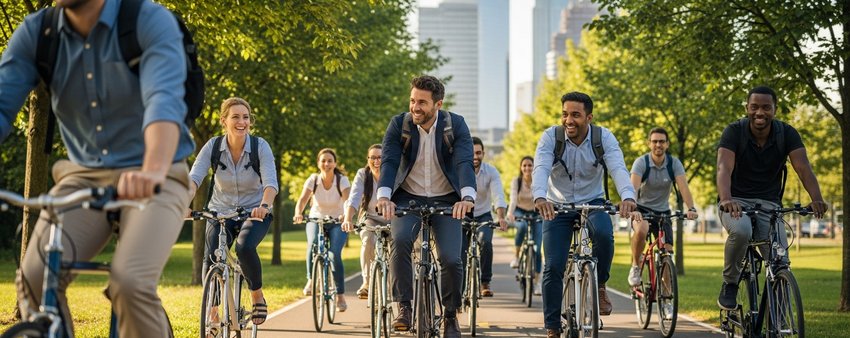
Here's a stat that might surprise you: sedentary office work costs U.S. employers roughly $54 billion per year in lost productivity. Meanwhile, study after study confirms that even moderate physical activity - like cycling for 30 minutes a day - can slash stress, reduce chronic disease risk, and lift the kind of brain fog that kills afternoon productivity. So why aren't more companies putting their employees on bikes?
A cycling challenge for employees is one of the most engaging, flexible, and cost-effective wellness initiatives an HR team can run. Whether your workforce is fully in-office, hybrid, or scattered across time zones, a well-designed cycling challenge gets people moving, talking, and competing in ways that a gym reimbursement simply can't match. In this guide, we'll walk through the benefits, the formats that actually work, and a step-by-step playbook for launching your first (or next) corporate cycling challenge.
Why Cycling? The Case for Pedal-Powered Wellness
Walking challenges have become the go-to corporate wellness activity - and for good reason. But cycling brings something different to the table. It's low-impact, meaning employees with joint issues or mobility limitations can often participate comfortably. It doubles as a commute, which means people can log challenge miles without carving extra time out of their day. And it carries a "cool factor" that walking sometimes lacks, especially for younger employees who might otherwise tune out wellness programs.
The health payoff is hard to argue with. Regular cycling improves cardiovascular fitness, strengthens lower-body muscles, and reduces the risk of chronic conditions like hypertension and type 2 diabetes. Research consistently shows that employees who cycle regularly report lower stress levels, better concentration, and fewer sick days. One European study found that employees who cycled to work took an average of one fewer sick day per year compared to non-cyclists - a modest number that adds up fast across a 500-person company.
There's also the mental health angle. Cycling outdoors exposes people to natural light and fresh air, both of which are linked to lower rates of anxiety and depression. Even indoor cycling on a stationary bike or smart trainer triggers endorphin release and improves sleep quality. For organizations already investing in mental wellness programs, a cycling challenge is a natural complement - it gives employees a tangible, daily action they can take to feel better.
Team Building That Actually Works
Let's be honest: most corporate team-building activities range from awkward to forgettable. Trust falls and escape rooms have their place, but they don't create the kind of sustained connection that shared physical challenges do.
A cycling challenge changes the dynamic. When a team of five is collectively chasing a 1,000-kilometer goal over four weeks, they check in with each other. They encourage the person who missed a couple of days. They celebrate when someone posts a personal best. That rhythm of mutual support builds real relationships - the kind that make cross-departmental collaboration smoother long after the challenge ends.
Group cycling requires communication, cooperation, and mutual support, and those habits carry over into daily work. Companies that have run cycling challenges report that they help break down departmental silos, especially when teams are intentionally mixed across functions. Picture a marketing coordinator, a software developer, and a finance analyst all tracking their rides together on a shared leaderboard. Those three people now have a reason to chat in the hallway or on Slack - and that social glue is worth more than any forced networking event.
For remote and hybrid teams, the effect is even more pronounced. Virtual cycling challenges give distributed employees a shared experience that doesn't depend on geography. Someone cycling through the streets of Austin and someone spinning in their Toronto apartment are both contributing to the same team goal. That sense of shared purpose is exactly what remote-first companies struggle to create.
Choosing the Right Format for Your Organization
Not every cycling challenge looks the same, and picking the right format can make or break participation. Here are the most popular options:
Individual Distance Challenge
Each participant tracks their own cycling distance over a set period (typically 2-4 weeks). A leaderboard ranks everyone, and top performers earn recognition or prizes. This format is simple to run and appeals to competitive personalities, but it can feel isolating for less active employees.
Team-Based Challenge
Employees form teams of 4-8 people and compete on total distance, average distance per member, or consistency (number of active days). This is the most popular format for a reason - it drives accountability and social connection without requiring elite fitness. Mixing teams across departments maximizes the team-building benefit.
Virtual Route Challenge
Participants collectively cycle the equivalent of a famous route - say, the Pacific Coast Highway (about 1,600 km) or the Tour de France stages. Progress is tracked on a virtual map, and milestones unlock fun facts or mini-celebrations. This format is excellent for storytelling and keeps people engaged because there's a tangible destination to reach.
Bike-to-Work Challenge
Focused specifically on cycling commutes, this format rewards employees who swap their car or transit pass for a bike. It ties wellness to sustainability goals - a win-win that CSR teams love. Some companies even track carbon emissions saved and tie cycling kilometers to tree-planting initiatives.
Hybrid Activity Challenge
If you want to include employees who don't own a bike or prefer other activities, consider a broader challenge where cycling is one of several tracked activities alongside walking, running, and swimming. Platforms like DistantRace let you set up multi-activity challenges where all movement counts toward team goals.
Setting Up Your Corporate Cycling Challenge: A Step-by-Step Guide
Ready to get rolling? Here's a practical playbook for wellness coordinators and HR managers.
Step 1: Define Your Goals and Timeline
Start by clarifying what success looks like. Are you trying to boost overall physical activity? Improve team cohesion? Support a sustainability initiative? Your goal shapes everything from the challenge format to how you measure results. Most cycling challenges run for 2-6 weeks - long enough to build habits, short enough to maintain excitement. A 30-day challenge is a popular sweet spot.
Step 2: Pick a Tracking Platform
You need a platform that syncs with popular fitness wearables and cycling apps. Look for one that supports Garmin, Fitbit, Apple Watch, Polar, and Strava-compatible devices. The platform should offer leaderboards, team management, and ideally virtual maps to visualize progress. DistantRace is built for exactly this kind of challenge - it handles team setup, automatic activity syncing from major wearables, and engaging virtual route maps that keep participants motivated.
Step 3: Set Rules and Inclusivity Guardrails
Make the rules clear and fair. Decide whether indoor cycling counts (it should - excluding it penalizes people in cold climates or urban apartments). Set a minimum ride duration to prevent gaming (10-15 minutes is reasonable). And consider weighting the challenge so that consistency matters more than raw distance. A "most active days" metric rewards the person cycling 20 minutes daily over someone who does one epic 100 km ride and then disappears.
Step 4: Build Your Communication Plan
A cycling challenge lives or dies on communication. Announce it 2-3 weeks before launch via email, Slack, and team meetings. Get leadership buy-in by having a VP or department head publicly sign up. During the challenge, send weekly updates with leaderboard standings, fun stats (total calories burned, equivalent carbon saved), and shout-outs for milestones. Mid-challenge energy dips are real - plan a "booster" event around the halfway mark, like a lunchtime group ride or a Q&A with a local cycling coach.
Step 5: Choose Meaningful Incentives
Prizes don't need to be expensive to be effective. Some of the best incentives for cycling challenges include bike accessories (lights, locks, water bottles), gift cards to local bike shops, an extra half-day off, or public recognition in a company-wide email. Consider also rewarding "most improved" and "most consistent" alongside "most distance" to keep motivation high across all fitness levels. Research shows that fair reward distribution across multiple categories increases overall participation and loyalty.
Step 6: Launch, Monitor, and Adapt
On launch day, make it an event. Share a kick-off message with a countdown, spotlight the teams, and post a short video from an executive who's participating. During the challenge, monitor engagement through your platform's dashboard. If participation drops in week two, don't panic - send a motivational update, highlight a comeback story, or introduce a bonus mini-challenge (like "Log a ride every day this week for a raffle entry").
Measuring Success Beyond the Finish Line
When the challenge wraps up, resist the urge to just announce winners and move on. The real value comes from what you measure and what you do next.
Track these metrics: total participation rate, average distance per participant, team completion rates, and post-challenge survey scores. Compare sick days and engagement survey results from challenge participants vs. non-participants if your data allows it. Harvard research suggests that well-run wellness programs can deliver an ROI of up to 6:1, with an average return of $3.27 for every $1 spent - but you need baseline data to prove it at your own organization.
More importantly, ask participants what they liked and what they'd change. Did the challenge feel too long? Were the teams the right size? Would they prefer a different format next time? This feedback turns a one-off event into a recurring program that gets better every cycle.
Making It Sustainable: From One Challenge to a Culture of Movement
The best cycling challenges don't end when the leaderboard resets. They spark something bigger.
Consider running cycling challenges quarterly - one per season keeps things fresh and gives people multiple entry points throughout the year. Spring and fall are natural fits (pleasant weather for outdoor riding), while winter challenges can emphasize indoor cycling and summer ones can tie into bike-to-work campaigns.
Some companies take it further by forming permanent cycling clubs, subsidizing bike maintenance, or installing bike storage and showers at the office. These investments signal that the organization genuinely values active lifestyles - and that message matters more to employees than any single wellness event.
Whether you're running a scrappy two-week challenge for a 50-person startup or a global virtual cycling event across 10 offices, the formula is the same: make it easy to join, fun to track, and social by design. DistantRace gives you the tools to handle the logistics - automatic syncing with Garmin, Fitbit, Apple Watch, and Polar, team leaderboards, and virtual route maps - so you can focus on what matters most: getting your people moving and connecting.
The hardest part of any wellness program is getting people to show up. A cycling challenge lowers that barrier by meeting employees where they are - on their commute, on their lunch break, on their living room trainer. Give them a team, a goal, and a leaderboard, and you might be surprised how far they'll ride.
Over ons
Hallo! Wij zijn DistantRace. Gedreven door onze passie voor sport streven we ernaar om uitzonderlijke ondersteuning te bieden bij het organiseren van ongeëvenaarde sportevenementen. Wij geloven dat iedereen toegang verdient tot de beste sportervaringen. Schrijf ons en we helpen je dit te realiseren!

Laatste Artikelen

Labels
TikTok
@distantrace
Inschrijven
Ontvang het laatste nieuws, kortingen en aanbiedingen.