Johnson & Johnson spent roughly a decade building one of the most studied wellness programs on the planet. The payoff? An estimated $250 million in healthcare savings and a return of $2.71 for every dollar invested. That number gets quoted in boardrooms for a reason. But here's what often gets lost: you don't need a Fortune 50 budget to copy what made it work. The best corporate wellness program examples share a handful of repeatable ingredients, and most of them cost far less than people assume. This guide breaks down what leading companies actually do, what the data says about results, and how to adapt these ideas for a team of 50 or 5,000.
What separates a wellness program that works from one that doesn't
Before the examples, it's worth naming the pattern. Programs that move the needle tend to share three traits: they make participation easy, they build in social accountability, and they measure something.
The data backs this up. In a 2024 Wellhub ROI report, 95% of companies that measure their wellness ROI report positive returns. Nearly two-thirds get at least $2 back for every $1 spent, and 91% report lower healthcare costs as a direct result. The catch is in that phrase "that measure." Programs without goals tend to drift, and drift is where engagement dies.
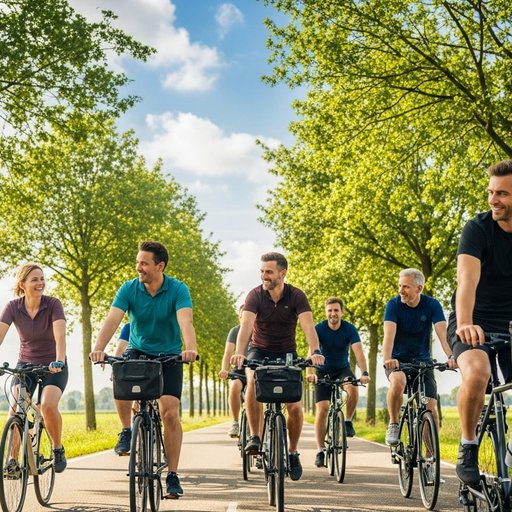
Team-based challenges are the single most appealing format to employees, with 36% naming them as their top choice. That's not a coincidence. Walking with coworkers toward a shared target turns a solo health chore into something closer to a group project, and people show up for their teammates in ways they won't show up for themselves.
Seven corporate wellness program examples worth copying
Here are real programs from companies of different sizes, with the specific elements you can borrow.
1. Johnson & Johnson: measurement as the foundation
J&J's program is famous for one thing above all - it tracked outcomes relentlessly. Over the years it linked wellness participation to biometric data, healthcare claims, and absenteeism. The lesson for a smaller company isn't the scale. It's the habit of picking two or three metrics (steps logged, participation rate, self-reported energy) and watching them over time. Without a baseline, you can't prove the program earned its budget.
2. Clif Bar: making movement part of the workday
Clif Bar offers paid workout time, an on-site fitness studio, yoga and massage rooms, and even a climbing wall. Its "Cool Commute" program pays cash incentives to employees who bike, walk, or carpool. Most companies can't build a climbing wall. But the underlying idea - give people permission and a small reward to move during the day - scales to any budget. A paid 30-minute walking break or a stipend for active commuting captures the same spirit.
3. Cisco: wellness built into the campus
Cisco's "Life Connections Center" combines primary care, fitness facilities, childcare, and outdoor trails in one place. The genius is removing friction. When healthy choices are the nearest choices, participation climbs on its own. Remote and hybrid teams can recreate this digitally by making the wellness platform the same tool people already open every day, rather than yet another login they forget.
4. Google: convenience at scale
On-site doctors, free healthy meals, subsidized massages, and full fitness centers define Google's approach. The theme again is convenience. You can't match the perks, but you can ask one question of every wellness idea: how many steps does it take an employee to participate? Fewer steps means higher uptake.
5. Accenture: mental health front and center
Accenture's "Thriving Mind" is a self-directed mental wellbeing program available to every employee. It reflects the biggest shift in workplace wellness right now - the merging of physical fitness with mental health, sleep, and stress management. A walking challenge that also frames movement as a stress-reduction tool, not just a calorie counter, taps into the same trend without new vendors.
6. Intuit: covering the whole person
Intuit structures its program around four pillars: physical, emotional, sustainable, and financial wellness. That last one matters more than many HR teams realize. Financial strain is one of the most common barriers to wellbeing, which is why coaching, budgeting tools, and savings support increasingly sit alongside fitness perks in 2025 and 2026.
7. The incentive-driven employer (U.S. Department of Labor case study)
One of the most striking results in the research comes from a Department of Labor case study. After switching from a voluntary program to an outcomes-based incentive model, one employer saw onsite wellness screening participation jump from under 20% to 99.8%. Incentives, done well, are the closest thing to a participation cheat code.
What the results data actually shows
It's easy to admire big-name perks. It's harder, and more useful, to look at what these programs produce. A few numbers worth keeping handy when you build your own business case:
- Participation: Platform case studies report sustained engagement above 70% and participation over 80% when challenges, leaderboards, and rewards are involved.
- Behavior change: A Department of Labor and PMC analysis found statistically significant improvements in exercise frequency, smoking behavior, and weight control - effects that held for four years.
- Absenteeism: Workplace wellness programs cut sick days by an average of 1.5 days per employee per year.
- Retention: Strong wellbeing strategies are linked to up to 11% lower turnover.
- Adoption: 97.8% of organizations now offer Employee Assistance Programs, and 94.8% provide virtual counseling.
Put together, the picture is consistent. The programs that win aren't always the most lavish. They're the ones that get people to show up, again and again, and then track whether it made a difference.
How to adapt these examples for your company
You won't build a Life Connections Center next quarter. So start where the leverage is. Pick one repeatable format that drives participation, layer in social accountability, and measure two or three numbers.
A step or movement challenge checks every box. It's cheap, it works for in-office and remote staff equally, and it naturally creates teams and leaderboards. Add a modest incentive tied to completion, communicate it like a real event rather than a memo, and you've borrowed the best parts of J&J's measurement discipline, Clif Bar's movement culture, and that Department of Labor employer's incentive structure - without their budgets.
Keep the bar low for entry and high for fun. The goal isn't to turn everyone into an athlete. It's to make the healthy choice the easy, social, slightly competitive choice for a few weeks, and then do it again.
Running your own wellness program with DistantRace
If those examples have you sketching ideas, the practical question is which tool ties them together. DistantRace is built for exactly this - step challenges, virtual races, and team competitions that work whether your people are in one office or scattered across time zones. It syncs with Garmin, Fitbit, Apple Watch, and Polar, so employees use the tracker they already own. Built-in leaderboards, team formats, and virtual maps supply the social accountability that drives those 70%-plus engagement rates, and the organizer dashboard gives you the participation data to prove the program worked. Big-company engagement, without the big-company overhead.
The takeaway
The best corporate wellness program examples - from Johnson & Johnson to Cisco to a Department of Labor case study that hit 99.8% participation - all rest on the same foundation: easy to join, social by design, and measured over time. You don't need their budgets to borrow their playbook. Pick one format that gets people moving together, give them a reason to start, and watch the numbers. Choose one idea from this list and build your first challenge around it this quarter.